Most crypto wallets quietly leak money. Here's the 60-second check.
Nobody notices a slow leak. That is what makes it a leak.
Most wallets are not losing money to hacks or bad trades. They are losing it to positions that were fine when they were opened and were never looked at again. Each leak is small enough to ignore, which is exactly why it adds up.
Here are the four we see most often, and how to check for each in about a minute.
1. Stablecoins sitting at zero
The most common leak is the most boring one: USDC or USDT sitting flat in a wallet for months, doing nothing.
Stables you are about to spend should sit still. But stables that are really savings have a cost, because onchain lending markets publish their rates in the open, and those rates have generally been meaningfully above zero. On a five-figure balance, a year of "I'll deal with it later" is real money.
The check: find your largest stablecoin balance and ask when you last made a decision about it. If the answer is "when I deposited it," take a look.
2. LP positions that drifted out of range
Concentrated liquidity positions only earn fees while the price stays inside your chosen range. Price moves out, fees stop. The position never alerts you. It just sits there, fully exposed to both assets, earning nothing.
We regularly see positions that have been out of range for weeks. The owner remembers opening them. They do not remember checking them.
The check: open each LP position and answer one yes/no question: is the current price inside my range?
3. Loans drifting toward the line
Borrowing against your crypto is normal. The leak is in the drift: collateral prices move every hour, and a loan that started comfortable can spend weeks sliding toward the level where liquidation becomes a real risk, with nobody watching in between.
Liquidation is the expensive version of a problem that was cheap to fix a week earlier.
The check: for each loan, find your health factor and ask whether you would open that same position today. If you are not sure where to even find the health factor, that is the finding.
4. Dust, forgotten approvals, and the long tail
Small stuff piles up: token dust across five chains, old contract approvals still live for apps you stopped using, rewards you never claimed. Each one is trivial. Together they are why wallets feel unmanageable, which is why nobody manages them.
The check: count how many tokens in your wallet you could not explain to a friend.
Checking is a job. Assign it.
None of these checks is hard. The problem is that there are four of them, across every chain and app you touch, and they need doing every week, not once. That is a part-time job, and nobody actually does it by hand.
So assign it. Set up your own AI crypto manager: Flip runs this exact checkup the moment you connect, then keeps watching.
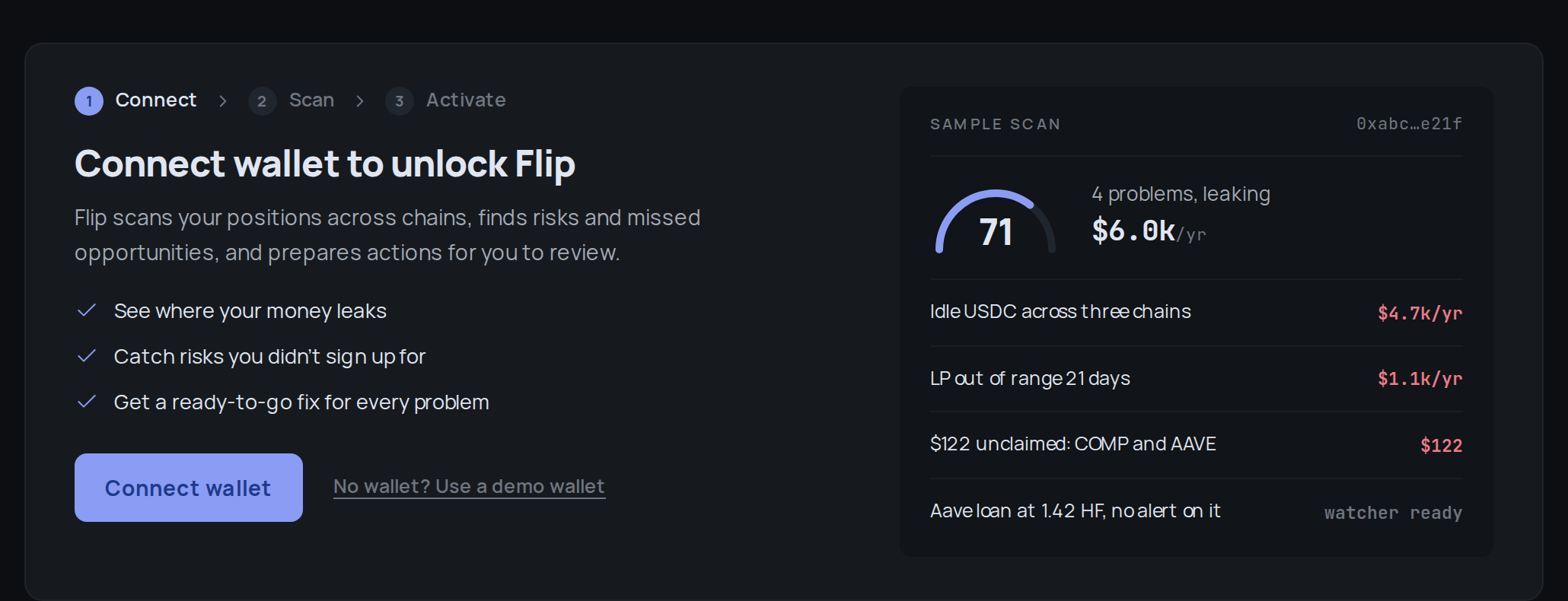
The scan in the app: every leak found, priced per year, with a prepared fix behind each one.
When something needs attention, it tells you in plain English:
- "You have $2,400 in unclaimed rewards."
- "This LP position moved out of its range 12 days ago."
- "Your USDC on Base is earning much less than your USDC elsewhere."
- "Your ETH loan is getting close to your risk limit."
- "I prepared a transaction to fix this. Review it whenever you're ready."
That last line is the whole product: Flip watches, explains, and prepares. It never moves anything on its own. You review every proposal and you sign every transaction, or you don't.
Flip manages the work. You control the money.
The first scan is free and takes about a minute.